What I'm thinking about
All notes →What I do
Your operating layer is mostly machine work. I take it over, rebuild it AI-native, and run it. Ten to twenty hours a week, real ownership.
Reporting, enrichment, pipeline hygiene, competitive intel, support triage: rebuilt as agent workflows under written rules, quality gates, spending limits, and silent-failure tripwires. People keep the judgment calls.
It starts with an audit. If we continue, I run the function while I build the machine. What you keep is the point: an operating system with my judgment encoded, still working and learning after I leave.
Your stack, your models. I build inside the tools you already run, on whichever model provider you choose. Sales, marketing, support, operations, finance.


Thirteen years, five countries
I've built and led GTM and operations teams across the United States, Canada, the Netherlands, Spain, and Brazil.
 SEOmonitorChief Revenue & Operations Officer · 2023–2026The CEO's operating partner across five functions. Re-architected GTM, hired the first CMO. Owned the internal AI roadmap.
 ConductorVP Enterprise Sales, EMEA · 2022–2023Ran the Northern Europe sales org. Led ContentKing's post-acquisition sales integration: enablement, training, process.
 ContentKingVP Global Sales · 2020–2022Built the enterprise sales org from scratch. Doubled ARR, 4×'d ASP in a year; instrumental in the 8-figure exit to Conductor.
 BotifyEnterprise Account Executive · 2019–2020President's Club. #1 globally in quota attainment, of 16 reps.
 PowerlingSales & Marketing Director · 2013–2019 · as Ccaps & OXORebuilt sales and marketing end to end. 131% average annualized growth; clients including Airbnb, Twitter, and the UN; opened the Canada market from Toronto.
A new kind of company: Flip Education ran this way
 Flip Education · flipeducation.ai
An AI co-teacher used in 18 countries and 11 languages. Two people built and ran it: a pedagogy expert who has trained over a thousand teachers, and me on everything else.
Launch took two weeks. Real reliability took two months. By staffing math, a year of work for 15 to 20 people. Day to day, 72 scheduled agents ran it: marketing manager, data analyst, support triage, cost accountant, competitive radar. One written charter, 50 quality gates, continuous evals, a daily cost ledger.
None of it is education-specific. The operating system transfers. The tooling is open source if you want to see how I work.
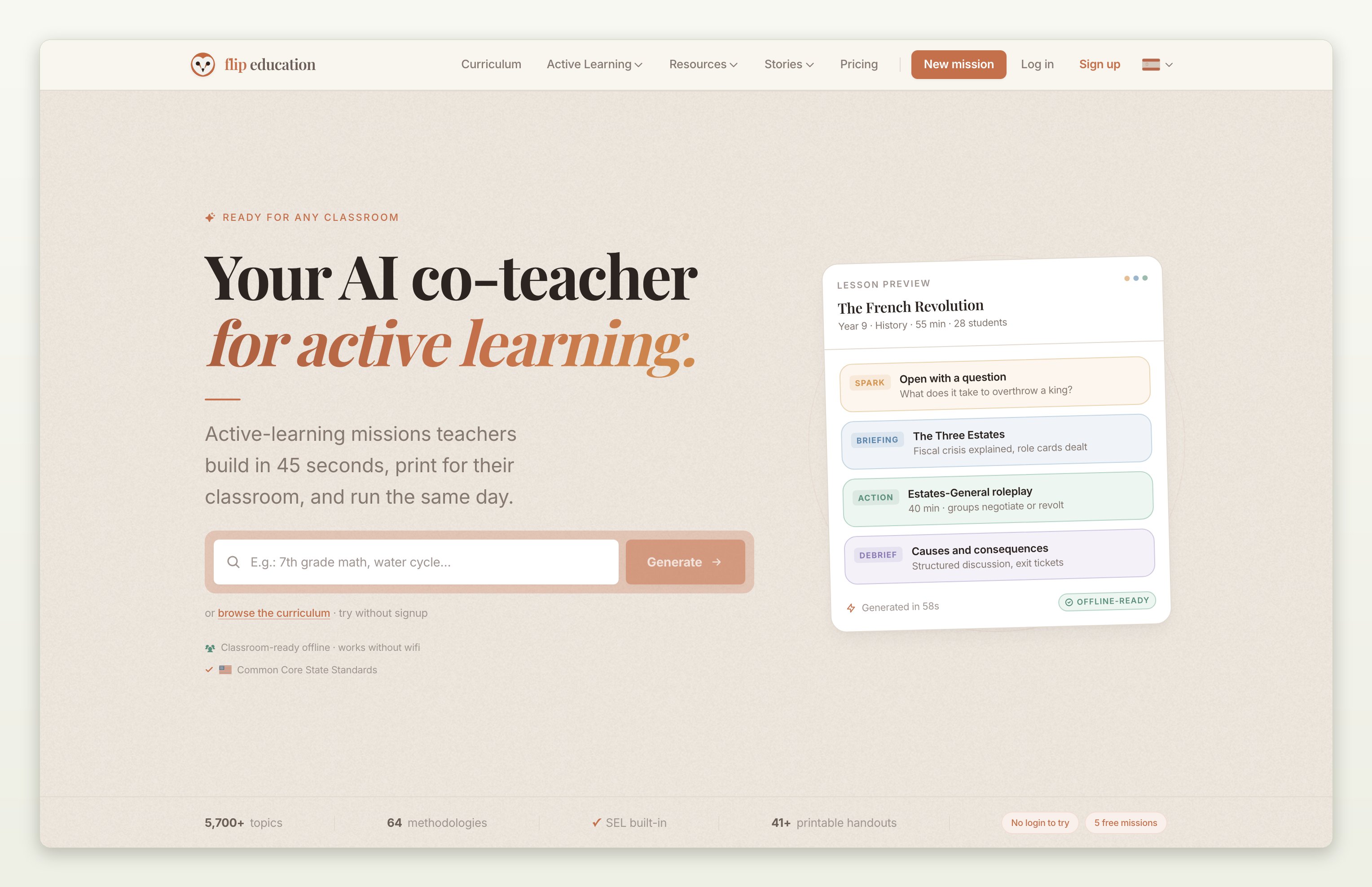
What an AI-run company looks like
Grouped the way a company is, ordered by impact. The mark means a real agent that ran Flip, and links to its repo once it is open source. The rest are patterns I build for clients.
Growth & marketing
A website you design, update, and run by describing the change in words, no rebuild and no agency retainer just to move a headline. Speed and independence on your own front door.
Writes, localizes, and ships. 960+ articles, 215K+ URLs indexed. Ran at Flip.
Every page and email in eleven languages, overnight. Growth without the translation bill. Ran at Flip.
Rankings, crawl health, and indexing checked daily; regressions flagged before traffic feels them. Ran at Flip.
Reads the market weekly: competitor launches, pricing moves, positioning shifts. Ran at Flip.
Onboarding, nurture, and win-back drafted from what users actually do. Ran at Flip.
Checks every cited fact and link in content against its live source, flags what changed, fixes what is fixable. Ran at Flip.
Scans every blog and content page for dead links, then drafts the replace-or-remove call for each one. Ran at Flip.
Gets the product listed where ChatGPT, Perplexity, and AI Overviews look for category answers, the reach plain SEO does not cover.
Sales & revenue
A full prospecting engine: sources, enriches, qualifies against your ICP, and drafts the first touch, with a relationship gate so nobody you know gets a template. Ran at Flip.
Every inbound scored, enriched, and on the right desk in minutes, not Mondays.
Keeps the CRM honest: stale deals chased, fields enforced, forecasts reconciled.
Meetings become structured records and follow-ups while you drive to the next one.
First-draft proposals and quotes from the call transcript and your price book.
RFI and RFP responses assembled from a maintained answer library, humans review the judgment calls, not the paperwork.
Customer success & support
A support chat built from scratch and wired to your own data, session replays, product events, account history, the context an off-the-shelf bot never sees. Ran at Flip.
Reads every ticket, answers the known, routes the new, escalates the risky.
Reads usage and support tone; names the accounts that go quiet before they leave. Ran at Flip.
Assembles the account-health pack before a check-in: adoption, tickets, ROI numbers. Ran at Flip.
Flags accounts hitting seat or usage ceilings, and features that correlate with upgrades.
Turns recurring questions into help-center pages so the queue shrinks itself.
Data & analytics
Daily scan of core metrics against baseline, with a first-pass diagnosis, not just a threshold ping. Ran at Flip.
Signup to activation to paid, read every morning, with what moved and why. Ran at Flip.
Plain-English questions answered from the warehouse, with freshness cited, so non-analysts stop interrupting the one who knows SQL. Ran at Flip.
Not just the metrics, the analysis: what moved, the likely cause, and what to do about it, written up weekly. Ran at Flip.
Watches running A/B tests, calls significance, and flags the ones quietly losing. Ran at Flip.
Product & engineering
The product was written by agents under direction: 996 production deploys in 58 days, two people, neither a full-time engineer. The frontier of what a fleet can carry. Ran at Flip.
Clusters requests from tickets, calls, and sales notes into a ranked demand list with real quotes. Ran at Flip.
Merged pull requests become user-facing notes, drafted per audience. Ran at Flip.
Dependency patcherOpens upgrade pull requests with the changelog digested and breaking changes summarized. Ran at Flip.
Reads session recordings for errors and UX friction, surfaces the rage-clicks and dead ends a dashboard never shows. Ran at Flip.
Assembles the timeline from logs and alerts, drafts the postmortem for the responder to correct. Ran at Flip.
Screenshots every key page on every deploy, in every language, and diffs what changed. Ran at Flip.
Agents that watch the other agents, catch the break, and fix or escalate before you wake up. Ran at Flip.
Reads the day's tech and infra news, filters for what actually changes cost, capability, or competitive position, stays silent on the rest. Ran at Flip.
Hunts functional bugs across every surface and locale in one pass: analytics finds the hot spots, visual and click-path agents verify each. Ran at Flip.
Security & reliability
Watches the whole surface: exposed secrets, dependency CVEs, anomalous access, config drift, and raises the alarm before it becomes an incident. Ran at Flip.
Every pipeline watched for the failure that makes no noise: outputs that stop changing. Ran at Flip.
Endpoints and backups checked on a schedule, so the first person to notice is not a customer. Ran at Flip.
Watches DMARC and sending reputation, because the quietest revenue leak is mail nobody receives. Ran at Flip.
Least-privilege sweep across every app; drafts the revocation list and the offboarding checklist.
First-pass answers from a maintained evidence base, gaps flagged, so enterprise deals stop stalling.
Audits the hallucination gate itself: percent of claims verified, what is expiring, what is bypassed and why. Ran at Flip.
Scans for data protection, privacy, and AI-regulation exposure biweekly, keeps a risk register a lawyer can pick up cold. Ran at Flip.
Finance & operations
A daily record of what every agent and API spends. Pre-spend gates stop surprises. Ran at Flip.
Categorizes, reconciles, and drafts the monthly close for a human to sign off. Ran at Flip.
Polite, persistent, and never forgets. Receivables age less.
Finds the SaaS you pay for and stopped using. Usually pays for itself in week one.
Job posts drafted, applicants screened against the bar, interviews scheduled.
Leadership & the operating system
Compiles the numbers, the anomalies, and the questions worth a founder's hour. Ran at Flip.
The whole fleet's week in one email: what shipped, what broke, what needs you. Ran at Flip.
Reads progress from the systems that hold the numbers and updates each objective, so the scoreboard is never a manual chase. Ran at Flip.
Metrics, narrative, and the raise tracker drafted from the systems that already know. Ran at Flip.
Reads the daily exhaust and maintains a living wiki a human or agent can consult months later. Ran at Flip.
The written rules every agent inherits before it plans: research first, kill your favorite hypothesis, verify against reality, fail loud. The judgment layer, not a task. Ran at Flip.
Written disciplines agents load as procedure: how to think, verify, pick models, find people. Ran at Flip. Open source: operator-skills.
Agent guardrailsGuard scripts between agents and their riskiest actions: secrets, spend, sends, scope, slop, silence. Open source: agent-gates.
Model evaluationWhich model runs each job, decided on evidence: rubric judging, cost and quality reports. Open source: pareto-evals.
The agent that reviews the other agents: audits prompts, checks fleet performance, recommends fixes it is never allowed to ship itself. Ran at Flip.
Watches for the correction you just gave an agent, catches the stale reference, proposes the fix to the skill or memory file. Ran at Flip.
Queue a check for next week, close the laptop, get the verdict by email on the date it is due. Ran at Flip.
Every plan tagged active, shipped, or superseded, linked to the commits that built it. Nothing gets replanned from scratch. Ran at Flip.
The expert bench, on demand
A contract lands, the agent reads it against your risk profile, returns the redlines and a plain-English verdict before you sign. Ran at Flip.
A market question at 9pm becomes a sourced brief by 10: competitors, pricing, sizing, with the contrarian view included. Ran at Flip.
Walk into every negotiation with the counterparty researched, positions priced, and a walk-away number agreed in advance.
Favorites from other builders
Not mine. Tools from others I use or rate, worth adopting before building your own.
Free, local, open-source dictation. Replaces paid tools like Wispr Flow, runs on your machine, your audio never leaves it.
Claude CodeThe agent harness my whole company ran on. The substrate everything else here assumes.
agent-skillsProduction-grade skills for coding agents, from Addy Osmani. The fastest way to raise an agent's floor.
gstackGarry Tan's opinionated Claude Code setup. A strong starting point if you're standing up your first fleet.
LibreCrawlOpen-source SEO crawler, a free Screaming Frog alternative. My old world, unbundled.
impeccableA design language that makes AI harnesses better at design. Drop it into your agent's context and every interface it ships gets sharper.
PaperclipThe open-source app for managing agents at work: assign, monitor, and review a fleet in one place.
Four ways in
Not sure where AI fits? I spend two to three weeks inside your operation. You leave with a function-by-function map, the reliability and cost gaps, and a sequenced plan with its economics.
My time: ~15 hours a week while it runsYou know what you need. I pressure-test the plan, then build and run it as your fractional COO.
My time: 10–15 hours a week, ongoingYour team executes. I direct from above on a fixed cadence, against a plan we agree on.
My time: 3–5 hours a weekStrategy on tap: AI operations, GTM, revenue. Bring the problem; we work it live.
Typically 2–8 hours a monthPrice bands move with team size and system count. Not sure which way fits? One email sorts it.
Email meraian@raianpollock.com
Get in touch

raian@raianpollock.com
LinkedIn